
Industries · Research, HPC & National Labs

The record-holder for moving research data.

Zettar zx set a U.S. national lab's petabyte record — a full petabyte across 5,000 miles in 29 hours, at 96% utilization, encrypted and checksummed. Get instrument and simulation data where it belongs for HPC centers, universities, and national labs — about 10× faster than rsync or Globus, on the DTNs you already run.

Who we serveHPC centersUniversitiesNational labsDTN operators
The problem

Instruments produce data faster than you can move it.

  • Light sources, telescopes, microscopes, and simulations flood storage faster than you can drain it.
  • rsync, scp, and Globus leave the expensive 100/400 Gb R&E networks you pay for running near-empty.
  • Your DTNs sit idle — the hardware can do line rate, but the software can't saturate it.
  • Multi-institution science means moving the same petabytes between facilities, again and again.
How Zettar solves it

Built in the world's most demanding science environments.

Pedigree

SLAC / ESnet / DOE

Engaged since 2015 on LCLS-II, a U.S. DOE exascale-class project. Winner of the Data Mover Challenge at Supercomputing Asia 2019. The proof is in production, not a slide.

Speed

~10× faster

About 10× the throughput of rsync or Globus — line rate, scaling out with no software ceiling. Finally use the network you already pay for.

Fit

Runs on your DTNs

Standard x86 and ARM servers, Linux, CUBIC as the default congestion control. No exotic hardware, no months of tuning — or take the turnkey appliance.

Collaboration

Facility to facility

Move petabytes between institutions and to the cloud. Latency-insensitive — validated over real 5,000- and 12,375-mile transfers, including Poland to Singapore.

Proof, not promises
"Zettar moved an actual petabyte over a 5,000-mile network loop in 29 hours — encrypted and checksummed — at 96% bandwidth utilization."
— SLAC National Accelerator Laboratory & ESnet, U.S. DOE Read the record → See the paper →

That run was capped at 80 Gbps to spare the shared network — on a full 100 Gbps link, it's a petabyte a day.

Proven withKEK — High Energy Accelerator Research Organization, JapanNCHC — National Center for High-performance Computing, Taiwan
"The flexible traffic engineering design of ESnet's network ensures that TCP-based transfer protocols can be used effectively for high-throughput data movement."
— Inder Monga, Executive Director, ESnet
Line rate
~90%+ of your bandwidth — scales out, no ceiling
The real setup

The hardware behind the record.

The SLAC / ESnet / Zettar system that moved a petabyte in 29 hours over a 5,000-mile loop — sending and receiving zx clusters, NVMe burst buffers, and ESnet's on-demand circuit.
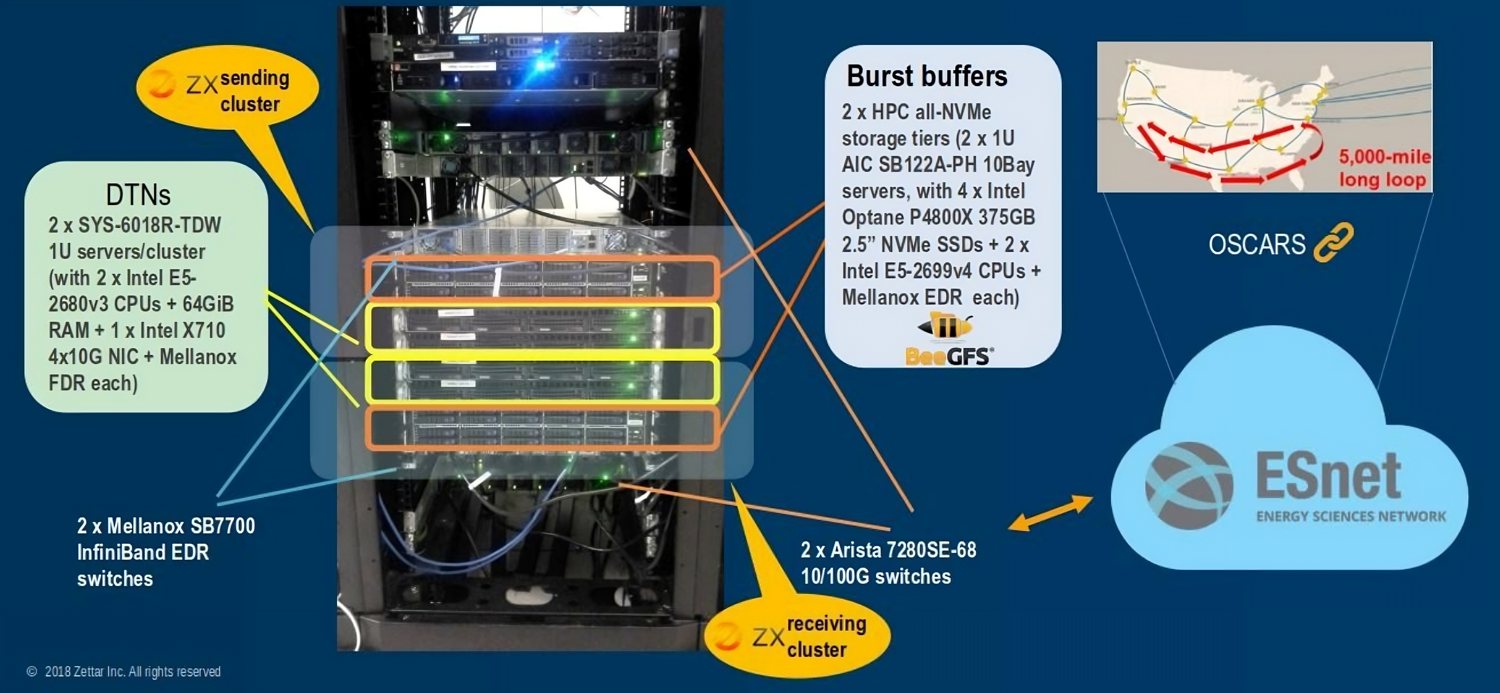
The SLAC/ESnet/Zettar testbed that moved 1 PB in 29 hours (2018): zx sending and receiving clusters, NVMe burst buffers, BeeGFS, and ESnet's 5,000-mile loop.
The 2018 record setup at SLAC. Source: Fang et al., “Reexamining Paradigms of End-to-End Data Movement,” arXiv:2512.15028 (CC BY 4.0).
Build your business case

Put a number on it — and make your case.

Get started

Use the network you already pay for.

See the zx Appliance move research data at speeds rsync and Globus can't reach.