
Move petabytes at wire speed — turnkey.
One validated box. Rack it and move data at wire speed on day one — pretuned, so your team never tunes a thing. zx moved 1 PB in 29 hours at 96% utilization, encrypted and checksummed.

The data-transfer engineering, already done.
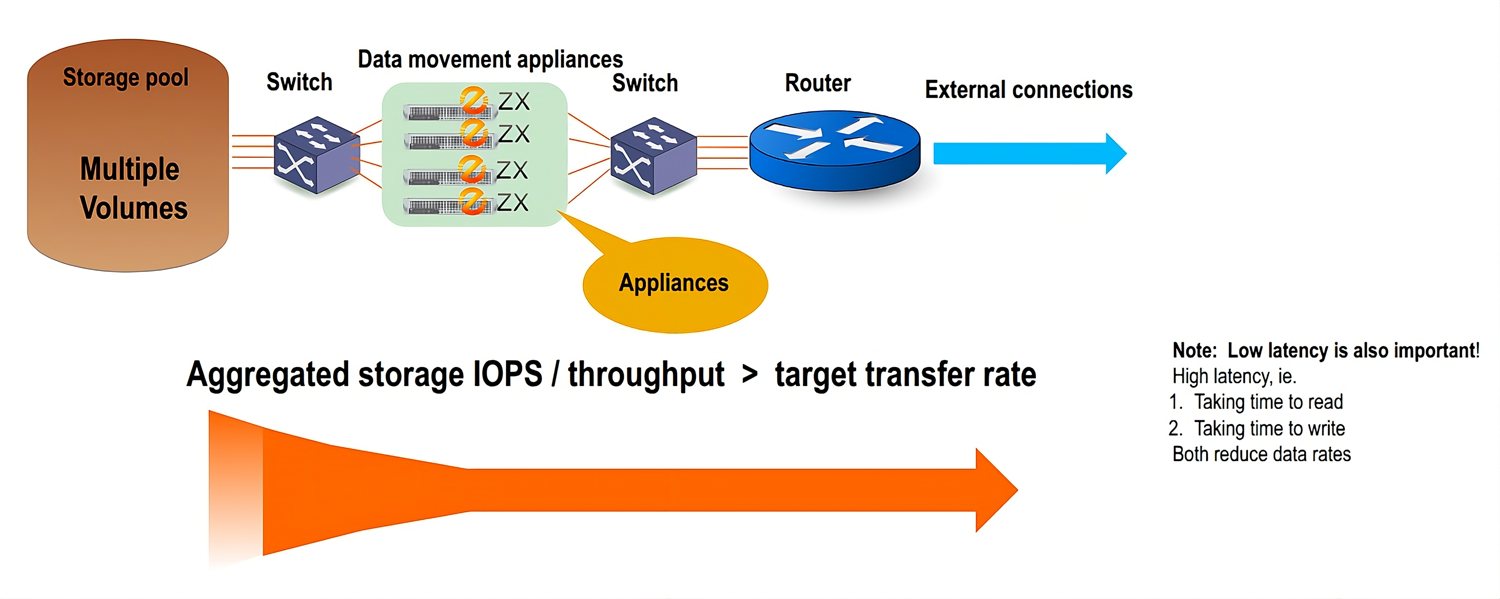
DIY on commodity servers means months of NIC, PCIe, NUMA, storage, and software tuning — and rarely reaches wire speed. We did that work and ship it as one co-designed appliance: nothing to integrate, tune, or troubleshoot, except mounting your storage.
Wire speed, no tuning
Zettar uses machine learning to find the best zx configuration for the matched hardware, then ships it preset, so it runs at line rate the day it’s racked — nobody on your team or your vendor's team tunes a thing.
Matched end to end
CPU, NIC, PCIe lanes, NUMA, storage, and software matched to saturate the network — the co-design that hits ~10× typical movers.
Enterprise-grade & supported
Enterprise hardware with global support and supply chain — one accountable solution, the procurement path you already trust.
One appliance. Every data path.
Powered by the Zettar zx unified data mover — file, object, local sync, and high-speed streaming in one stack. A unified mover proven at petascale (1 PB in 29 hours), and winner of the Supercomputing Asia 2019 Data Mover Challenge.
Bulk file and file↔object (coupled with zx Object) transfers at petascale, with massive parallelism.
S3-compatible — object↔object and file↔object, high concurrency with multipart movement.
Scale-out local copy and sync — a far more efficient rsync counterpart for cluster-scale data.
Stream live, fast-growing data at line rate the moment it's produced — scaling out with no software ceiling.
From a 10 Gbps edge box to datacenter scale-out.
The same pretuned zx data mover, sized to the link you need to fill. Three base configurations below — and beyond Core, zx scales out across nodes for 400 Gbps+ and embeds directly in NVIDIA and Intel DPUs.
| Tier | Core |
Mini+ |
Mini |
|---|---|---|---|
| Appliance-base hardware examples | HPE ProLiant DL380 Gen 12 | HPE ProLiant DL20 Gen 11 | HPE ProLiant DL20 Gen 11 |
| Max network speed | 100 Gbps | 25 Gbps | 10 Gbps |
| CPU | 2× Intel Xeon 6520P (24 cores, 2.4 GHz) | Intel Xeon 6353P (8 cores) | Intel Xeon 6353P (8 cores) |
| Memory | 512 GB DDR5 | 64 GB DDR5 | 64 GB DDR5 |
| Burst buffer | 8× 6.4 TB NVMe (RAID 0) | 2× 4 TB NVMe (RAID 0) | 2× 4 TB NVMe (RAID 0) |
| Networking | 100 GbE / HDR100 (both dual-port) + 2× 25 GbE | 2× 25 GbE + 56G IB | 2× 10 GbE |
| Power | 1800–2200W | 800W internal | 500W internal |
| Dimensions (H × W × D, SFF drive configuration) | 3.44 × 17.64 × 31.54 in (8.75 × 44.80 × 80.11 cm) | 1.69 × 17.11 × 15.25 in (4.32 × 43.46 × 37.84 cm) | 1.69 × 17.11 × 15.25 in (4.32 × 43.46 × 37.84 cm) |
Representative configurations, all on HPE ProLiant enterprise servers. Need more than 100 Gbps? Core scales out linearly — about one node per 100 Gbps — every tier sharing one co-designed stack and NVMe burst buffer. Get the one-page datasheet →
Turnkey — on enterprise hardware you already trust.
The zx Appliance arrives pre-integrated, validated, and pretuned — racked and moving data at wire speed on day one. Zettar delivers and supports the complete system as one solution, on HPE, an enterprise platform your organization already trusts.
Delivered and supported as one
Record-setting Zettar software and enterprise server hardware — quoted, delivered, and supported together as one appliance, with a single point of contact.
Engineered, not assembled
One configuration, integrated and tested end to end — it racks as a single unit and runs at wire speed, with nothing to source, assemble, or tune on site.
Built on HPE ProLiant
Core runs on the HPE ProLiant DL380 Gen 12 and the Mini tiers on the ProLiant DL20 Gen 11 — enterprise servers your procurement, datacenter, and support teams already know.
Enterprise hardware. One accountable solution.
Zettar selects, matches, and pretunes every hardware component to the zx data mover, then delivers and supports it as one solution. The proven core configuration is the HPE ProLiant DL380 Gen 12 — pairing zx with enterprise hardware, global support, supply chain, and the procurement path your organization already trusts. The result: one accountable solution, a lower total cost than a DIY transfer stack, and far less engineering time to stand up and run.
Talk to us about the appliance →Built for your security team’s review.
Secure transfer that fits the controls you already run — encryption and integrity on every move, your identity provider, bandwidth you govern, data in native formats.
Every byte verified
Encrypted in flight and checksummed end to end, so integrity is confirmed on every transfer.
Your IAM, not another silo
Active Directory, OpenID Connect (OIDC), and Bearer tokens — no separate user store to provision or audit.
Control what moves, and when
Built-in Quality of Service (QoS) caps each transfer's bandwidth, so production traffic keeps its share.
Your data stays yours
Data moves in native formats across your hardware and clouds — no proprietary lock-in, no exit toll.
Configurations are published and independently reproducible, so your security team can validate behavior before deployment. See security & compliance →
How many appliances — and what would they save us?
Common questions
What is the fastest way to move a petabyte of data?
Move it in parallel at line rate, not with single-stream tools. zx, the software inside the appliance, moved a full petabyte in 29 hours at 96% link utilization with SLAC and the U.S. DOE — about a petabyte a day on a 100 Gbps link — turnkey and supported as one solution.
What does line rate, or wire-speed data movement, mean?
Moving data at roughly 90% or more of what your end-to-end path — storage, hosts, and network together — can sustain, instead of the small fraction single-stream tools like rsync or scp reach. zx is co-designed to realize line rate; it hit 96% of a 5,000-mile link in the SLAC and ESnet petabyte record.
What is a data-movement appliance?
A turnkey system that co-engineers hardware and software to move data at wire speed out of the box — no integration or tuning. Zettar selects and matches the hardware components, then the hardware and the zx software are optimized together. The entire resulting system is delivered as one supported solution.
Does my team or hardware vendor have to tune it?
No — nobody on your team or your hardware vendor tunes anything. Zettar has already done the optimization and ships it preset, validated to hold line rate across 10–100 ms paths and on 5,000- and 12,375-mile transfers. The appliance arrives ready to move data at wire speed the day it is racked.
What do you mean by scale-out, and is there a bandwidth ceiling?
zx is symmetric and peer-to-peer: every node both sends and receives, clusters self-organize and self-heal, and aggregate throughput grows as you add servers. There is no software ceiling — performance is set by your whole environment (storage, hosts, and network together), and zx is co-designed to realize it. Where the path is capable, it scales out to fill very large pipes — up to 1.6 Tbps, as on Taiwan's research networks.
What hardware does it run on?
The zx Appliance is built on HPE ProLiant servers — the DL380 Gen 12 for Core and the DL20 Gen 11 for Mini and Mini+ — and is quoted, delivered, and supported as one solution. Your data stays in native file and object formats, so nothing is locked in. If your organization has a hard hardware requirement, talk to us.
How is it different from rsync, Globus, or Aspera?
Each falls short differently at scale: rsync is single-stream; Globus orchestrates transfers but leaves throughput to the endpoints you tune; Aspera and Signiant are closed, proprietary, per-GB-licensed software. zx is petascale-proven (1 PB in 29 hours), turnkey, and roughly 10× typical movers, with no lock-in — instead of a months-long DIY tuning project.
How do we buy and support it?
It is quoted, delivered, and supported as one appliance — Zettar software plus enterprise hardware support and global supply chain from HPE, through the procurement path you already trust. zx is licensed as an annual subscription, per node, with support included.
Do we need to install anything in the cloud?
No. Nothing from Zettar runs in the cloud. The zx Appliance stays on your premises, and zx Object acts as an S3-compatible client, reading from and writing to cloud object storage directly.
See it move a petabyte.
Schedule a demo and watch the zx Appliance saturate your network — then map it to your environment and a deployment plan.